I like to understand WMI (Windows Management Instrumentation) as a database, main concepts are:
Namespaces: Databases
Classes: Tables
Properties: Columns
Instances: Lines
Values: Fields
With this in mind, we can start enumerating all the namespaces we can access locally.
using System;
using System.Collections.Generic;
using System.Text;
using System.Management;
namespace WmiNamespace
{
class Program
{
static void Main(string[] args)
{
//Represents the scoop for management operations
ManagementScope ms = new ManagementScope();
//Provides a wrapper for building paths to WMI objects
ManagementPath path = new ManagementPath(@"\\localhost\root");
ms.Path = path;
ms.Connect();
if (ms.IsConnected)
//At this point we are connected to WMI
{
//Represents a management query that returns instances or classes
ObjectQuery wql = new ObjectQuery("select * from __Namespace");
//Retrieves a collection of
//management objects based on the specified query
ManagementObjectSearcher searcher =
new ManagementObjectSearcher(ms, wql);
//Represents different collections
//of management objects retrieved through WMI
ManagementObjectCollection oc = searcher.Get();
//Represents the enumerator on the collection
ManagementObjectCollection.ManagementObjectEnumerator oe =
oc.GetEnumerator();
while (oe.MoveNext())
{
foreach (PropertyData prop in oe.Current.Properties)
{
Console.WriteLine("\t{0}", prop.Value);
}
}
}
Console.ReadLine();
}
}
}
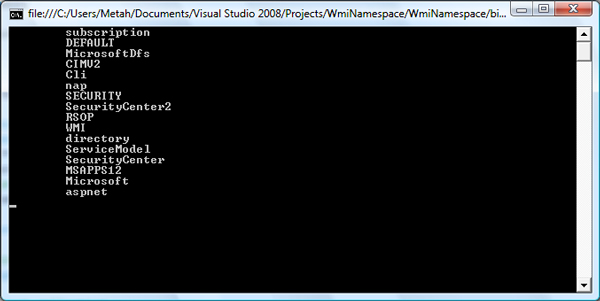
Running this program will display:
|
Next step is to enumerate all classes from a Namespace. This will come at next post :)
Ahmet
very nice and very helpful
thanks a lot.